
Summary
A moisture meter can support observation, but a number on a dial is not a universal watering instruction.
Different plants tolerate different drying patterns. A succulent, fern and fruiting tomato should not share one target reading. Pot size, growing medium, temperature and root development all affect moisture use.

Start with the
plant and its pot
Different plants tolerate different drying patterns. A succulent, fern and fruiting tomato should not share one target reading. Pot size, growing medium, temperature and root development all affect moisture use. Before buying a meter, learn how the pot feels when watered and how quickly it becomes lighter.
Understand what
inexpensive probes do
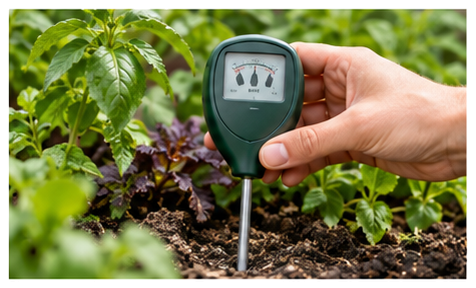
Many simple probes infer moisture from electrical properties of the surrounding material. Their readings can vary with salts, contact and the type of mix. They do not measure every part of the root ball at once. Treat the result as a comparison in the same pot over time rather than a laboratory measurement or a precise percentage.
Take a useful reading
Follow the device instructions for insertion depth and cleaning. Avoid forcing the probe through dense roots or against the pot base. Check more than one location if readings seem surprising. A moist surface can cover a dry interior, while one wet pocket near a dripper can make the whole pot appear adequately watered.
Cross-check before acting
Use a finger where practical and compare the weight of a manageable container. Look for drainage problems if the medium stays wet for a long time. Wilting can occur with either dry roots or damaged waterlogged roots, so watering immediately is not always the answer. Investigate inconsistent readings rather than chasing the dial.
Buy for the actual task
Check whether the device is intended for soil or container mixes, whether batteries are required and whether the probe is replaceable. A clear display and robust construction may matter more than multiple unverified functions. Do not assume a combination moisture, pH and light device is equally reliable at all three tasks.
Keep it as one tool
A meter is most useful when reaching into a large pot is difficult or when you are learning a new watering routine. It is less useful if it encourages you to stop observing plants. Clean and store it according to the instructions; many basic probes are not intended to remain permanently in the soil.