
Summary
A durable gravel path depends on its route, edges and base as much as the stone you see on top.
Use string or a hose to lay out the path and walk it carrying a watering can. Check turns, door clearances and the space needed to pass plants at their mature width.
Mark the route at full size
Use string or a hose to lay out the path and walk it carrying a watering can. Check turns, door clearances and the space needed to pass plants at their mature width. For wheeled access, loose gravel can be difficult; consider a firm alternative or a suitable stabilised system before committing.
Understand drainage
and ground conditions
Watch where rainwater flows before digging. A path should not direct water towards a house or block an existing drain. Depth and base construction depend on soil, expected use and local conditions, so seek site-specific advice for major work or drainage changes. Locate buried services before excavation.
Give gravel a defined edge
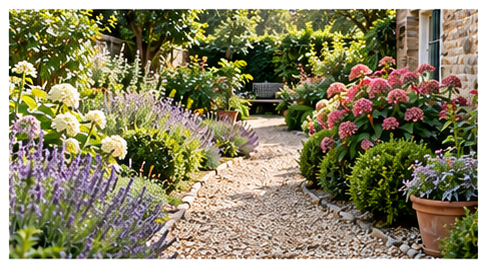
A restrained edge reduces migration into beds and lawns. Choose something robust enough for the route and install it securely without creating a trip hazard. Avoid sharp exposed metal corners. Smooth curves are usually easier to maintain than many tight bends, especially beside grass that needs mowing.

Choose stone by function
Try a small sample underfoot. Rounded pebbles tend to move more than angular gravel, and large pieces can be awkward for chairs, barrows or footwear. Colour changes when wet, so view the sample in both conditions. Avoid choosing very pale or very dark stone only from a catalogue photograph.
Do not rely on fabric alone
A suitable separator can help keep layers distinct in some designs, but it does not eliminate weeds forever. Wind-blown seeds can grow in debris above it. Follow the chosen construction specification and keep the finished surface at a sensible level below door thresholds and nearby soil.
Maintain little and often
Rake displaced stone back, remove leaves before they break down and pull small weeds while they are easy to remove. Replenish only where necessary rather than continually burying the edge. A simple route with well-kept boundaries generally looks calmer than elaborate patterns that are difficult to maintain.